
BUY TIMBER
Gablok + DesignWood Timber Pricing
Engineered timber solutions designed for builders, developers and construction partners. Market-aligned pricing across structural, engineered and sheet timber products.
| Category | Product | Size | Use Case | Market Range | Price |
|---|---|---|---|---|---|
| Engineered Timber | LVL Termispan H2S | 100x45 | Bearers & Joists | $5.96–$6.30 / LM | $5.10 / LM |
| Engineered Timber | LVL Termispan H2S | 100x63 | Load-bearing framing | $8.35–$8.82 / LM | $7.50 / LM |
| Engineered Timber | LVL Beam | 200x45 | Structural support | $13.28 / LM | $12.20 / LM |
| Glulam | Pine Glulam GL17C | 195x85 | Structural beams | $77.51 / LM | $76.50 / LM |
| Glulam | Pine Glulam GL17C | 260x85 | Large spans | $99.99 / LM | $98.90 / LM |
| Treated Pine | MGP10 / F7 DAR H3 | 90x45 | Wall & floor framing | $4.85–$5.75 / LM | $4.30 / LM |
| Treated Pine | MGP10 / F7 DAR H3 | 140x45 | Bearers | $7.28–$7.87 / LM | $6.50 / LM |
| I-Joist | I-Joist H2 | 240x63 | Floor systems | $13.84–$14.04 / LM | $12.80 / LM |
| Sheet Product | Structural Ply F11 | 2400x1200x17mm | Flooring / sheeting | $48.00–$56.40 | $47.00 |
| Sheet Product | Marine Ply | 2400x1200x12mm | Wet areas | $70.20–$80.86 | $69.00 |
| Flooring | Particle Board | 3600x800x22mm | Subfloor | $53.78–$66.23 | $52.00 |
| Decking | Treated Pine Decking | 90x22 | External decking | $3.34 / LM | $2.30 / LM |
Pricing excludes GST, delivery and project-specific variations. Final pricing may vary based on volume, treatment level and availability.
The wood frame self-build kit in detail.
Our wood frame self-construction kit is made up of just 8 elements:
1. General insulated blocks
2. Isolated starting blocks
3. The connecting elements
4. Belt wooden blocks
5. Start and top rails
6. Floor elements
7. Lintels
8. Beams
In addition to these 8 components, you will also receive all the necessary screws and fittings to construct your frame from the plan.

Can self-build blocks be used to build any size house?
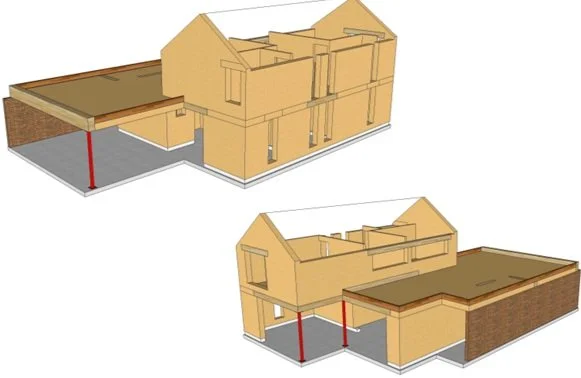
The Gablok self-build system has been designed to form the frame of most structures with the insulated wooden blocks designed to fit together to form the main structure of a residential building. When drawing up the plans for your Gablok home, we conform as closely as possible to the developer’s needs so that you can build your dream home house with ease.
We also adapt the design plans to suit the type of finish needed, whether that be cladding, brick veneer or render. Also, the dimensions of door and window openings are established in advance so you’re able to order the necessary components to install directly after the construction of the structural work is completed.
How do the different insulated wooden blocks fit together?
No jointing system is required for self-building with Gablok blocks because the wooden blocks fit together like interlocking building block toys to form the structure of the house. The individual insulated wooden blocks of the outer walls are secured together by a system of vertically laid battens. When a storey is finished, these battens - attached vertically every 40 cm - support not only all the blocks forming the floor but also the bottom plate and the embossed top plate with the screws provided. When a wall is finished, a second plate (the embossed plate) is inserted into the last stack (Blocks under ceiling or insulated belt blocks). This acts as a belt and support for installing the floor components.

What type of insulation is used in our self-build blocks?
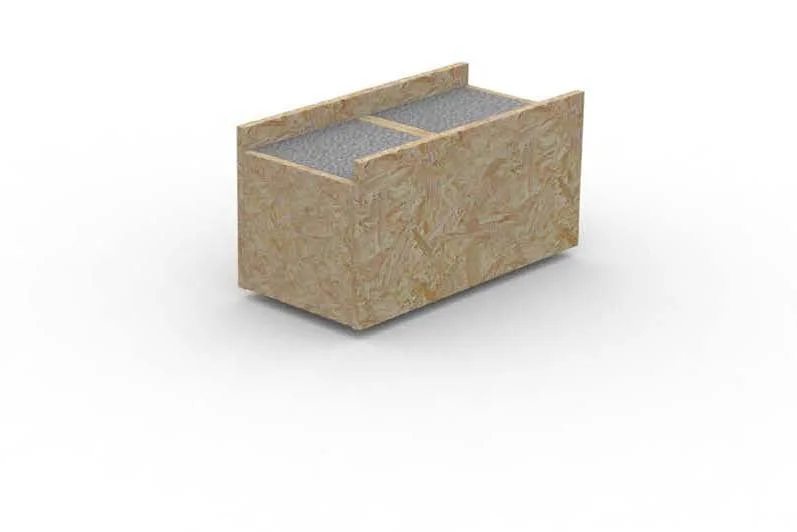
Among all the insulators available, Gablok has made the choice of expanded polystyrene with graphite additive (EPS) for its building system.
EPS is about 98 % air. The remaining 2 % is material derived from oil refining. EPS gives a second life to this material that could not have been used as a fuel. EPS remains stable over time, it has no negative impact on the environment and it is neither toxic nor polluting.
EPS is environmentally friendly and has a high-performance insulation system. The carbon footprint of a traditional house or timber frame insulated with EPS will be superior to that of a masonry construction. EPS requires less transport given its small size (the beads increase their volume by 40 times their size into contact with water vapour without solvents or other adhesives) and takes up less space. Because of its expanding capacity, it does not use considerable amounts of water and energy to increase its shape.
EPS is a recycled and recyclable product. An alloy of wood and EPS is manufactured for impressive performance. The EPS insulation designed for Gablok insulated wooden blocks is combined with OSB formwork. The blending of wood and EPS allows Gablok constructions to benefit from a very interesting insulating value and energy performance.

What is Gablok’s energy performance, thermal insulation, and EPB?
The EPB is examined on a case-by-case basis, depending on the site. The energy performance of buildings (EPB) is calculated according to a number of specific criteria, the value of which differs according to the type of dwelling. These criteria correspond to the dwelling’s defining characteristics.
For example: the different types of insulation used (roof, external walls, internal walls, etc.), the type of window frames and surface, the orientation of the house, and the heating system proposed. The thermal conductivity (“U” value) of a wall built with Gablok is 0.15 w/sqm²k. The insulated wooden blocks are suitable for 2021 EPB values. Today, the thermal conductivity required by the EPB for a wall is U = 0.24 w/m²k , without applying additional external insulation when the thermal conductivity of a passive house wall is U = 0.10 w/m²k.
